Sunday, 18 October 2015

The Lares Valley and Machu Picchu

 Where to start with our tour of the Lares valley in Peru and our visit to Machu Picchu.

We landed in Cusco, the tourist mecca for trekking and visiting the Sacred Valley and Machu Picchu.  Cusco is a very old city that pre-dates even the Inca empire.  Its high elevation (3,300 metres) makes it an excellent place to acclimatize for high altitude hiking.
Cusco
The city is full of wonderful old Inca buildings, Spanish cathedrals, and narrow cobbled streets.  This is overlaid with a massive tourist population, hordes of hawkers and touts, blocks of souvenir and travel shops, and a mad amount of cars, cabs and motorcycles fighting with pedestrians for street space.  I think the city  is on the cusp of becoming too touristy, as this is now one of the major industries for Cusco and Peru.

The tourist plague, however, does mean that the food is more cosmopolitan and it is possible to get good vegetarian food and decent coffee in many places.  The local lemonade is also freshly made and excellent.  Cusquena is a local beer that is available in dark (Negre) and Bill found it tasty.

We spent two and a half days recovering from our Ecuadorian digestive disorder and walking all over the city.  My favourite site was the Qorikancha, a Dominican mission built on and around an Inca temple of the sun.
Qorikancha Inca temple inside the Dominican Monastery

 You can still see parts of the old temple inside the Dominican structure.  We also did a "free" walking tour of the city, led by Elvis, who showed us some of the odder sights of the city with great enthusiasm.  Inca wall restorers, cleaning rock walls with toothbrushes to remove lichen and algae that erode the stones, were a sight worthy of a Monty Python sketch.

Our tour with Mountain Lodges of Peru was a beautiful way to see some of the mountains and villages in the Sacred Valley on the way to Machu Picchu.
Lake in the Andes
 We stayed two nights at their lodge at Lamay and two nights at another Mountain Lodge at Huacahuasi.  Both of the lodges were in smaller (Peruvian) Indian villages that do not get so many tourists.
Archaeological site of An Samaria (food storage ruins) 

 They work with the locals to provide high level  accommodation and food, as well as job opportunities and training for the locals.  Both of the lodges were beautiful, clean and comfortable with very good food, including tasty vegetarian options.  They also offered wonderful extras for tired hikers including spa baths and massage.

Each day we had a choice of cultural activities such as visiting archaeological sites or local markets,  or hikes of varying degrees of difficulty through the mountain passes.  Mountain biking along the river was also an option.
On hikes we  were always accompanied by guides, as well as Indian helpers who brought horses or donkeys with emergency equipment and emergency rides if a hiker could not continue.
Archaeological site
The first couple of hikes were very painful and every breath was laboured on the uphill climbs. It was good to know that the horse named "911" was with us carrying oxygen and first aid supplies.  Although, as one of the other hikers said, he was ashamed to see the one Indian helper was a young woman with a 15 month old baby that she carried and nursed as she herded the donkeys along, and spun wool with a drop spindle as she had so much free time while the hikers were gasping for air.
Support Crew in Peru 

Ollantaytambo
The archaeological sites were numerous and often staffed by locals who demonstrated crafts or sold hand made items on site.  The markets sold many varieties of fruit and vegetables, as well as fresh baking in huge wood-fired ovens,
Village Bread Oven
live guinea pigs to purchase for lunch or dinner, and fresh and dried meat.  There are over 90 (or maybe it was 900) varieties of potato available, and most markets had dozens of different kinds to chose from.  Peru is a massive exporter of fruit, vegetables and flowers to the world;  agriculture and tourism are both major industries.

Guinea pigs for food. 
Potatoes varieties at the market 
Our last two nights were spent in Ollantaytambo, the oldest continuously inhabited settlement in South America and Aguas Calientes, the jumping off point for Machu Picchu.  After all of our hikes through very lightly populated areas and mountain passes up to 4,500 metres, Machu Picchu was a bit of a let down.  The site is reached by a treacherous, gravel mountain road, single lane at places and full of switchbacks.
 You have to travel  from Ollantaytambo by train to Aguas Calientes and then to Machu Picchu  by bus.  The buses are stuffed full of tourists and shuttle every 5-10 minutes up  and down the mountain, often having  to back up at narrow spots in the road.
You guessed it! 
Machu Picchu itself is very large and well preserved, and swarming with tourists.  They discourage long visits by having no toilets inside the site and no eating allowed in the main park area.  After our lung-busting week of climbing in the Sacred Valley, the hike up Huayna Picchu (the mountain overlooking Machu Picchu) was a dawdle.  We had 3 women over 60 in our group and we were passing much younger people going up the trail.

The view from Huayna Picchu was beautiful, and we had excellent hot and clear weather for our visit.
View of Machu Picchu and access road from Huayna Picchu 
The stay at Machu Picchu was relatively short, however, from about 8:00 til 13:00, then we had to catch our train to Ollantaytambo and bus back to Cusco, bringing our trip to a quick end.  Our next stop is Los Angeles and the southern USA for the last two weeks of our trip.  Looking forward to Mexican food and margaritas.  Ole!

Wednesday, 7 October 2015

Ecuadorian Amazon

Followers,
The last night in Quito we had an excellent Italian meal with extras (Bruccetta to start, shot of liquor on ice cream to end) in a restaurant with a locked door, we flew the next day to Coca.
Here we took a motorized boat 2. 5 hours down the Napo river (a tributary of the Amazon). The river was very wide but shallow, with oil exploration operations and villages along the shore. These decreased as we approached the lodge dock. There we walked 30 minutes along a track, partially board walk, to a waiting canoe.
A small Anaconda was seen just off the dock. The canoe then took us along a channel into the lake where the Lodge was located. An adventure already!
The next 5 days we wandered the rainforest, and were paddled through the channels off the lake. Discovering spiders, birds and plants with medicinal properties. One of these,  sour cane, seemed helpful after stomach problems we had from a local village lunch.
Bobbie found walking the primary rainforest claustrophobic,
but when viewed from tall towers connected by walkways overlooking the canopy she enjoyed the bird watching. One tower was built around a giant kapok tree taking you 55 metres up above the jungle canopy.
One afternoon we went piranha fishing next to the swimming ladder. See the result.
Yes, Bobbie did swim in the lake twice, but found the water hot for swimming, and very dark. She was assured that piranha only eat dead meat.
During our canoe excursions the most interesting birds were the yellow backed Oropendolas. Their nests were hanging baskets in the trees.
Food was very good at the lodge with cold beer and excellent lemonade - freshly made. One night was a BBQ with an Eclipse of the moon thrown in.
The return to Quito was again a 2 hour trip up the river, this time with some of the local villagers using the free transport the lodge provided to support tahe development of the surrounding communities.
Again the oil company activity on the river seemed other world, and you questioned how long the river communities could continue to farm and fish as they had for centuries.
We are writing this from our luxury Mountain Lodge in Peru, on our way to Machu Picchu. The first day we did a 6 hour hike to 4,435 metres  (14,550 feet) through the Huallata Pass. But more in the next blog.
Cheers Bill and Bobbie

Wednesday, 30 September 2015

Quito Ecuador  25 September 2015

Hello occasional followers and others.  I can't believe it has been almost two weeks since we started our trip to the Americas.  We have done so much it is hard to keep straight in my mind, even with the help of my diary.

We left Australia on September 11 via an incredibly crowded Sydney airport.  Took us a good 2 hours to check in and clear security and customs.  LIne ups everywhere in the international terminal.   Half of Australia seemed to be on their way to somewhere else.

Our flight to Santiago Chile was as pleasant as flying in cattle class ever is, and landed on time.  We caught a bus and the new and very reasonable metro to the city and found our way to the airbnb apartment with our friendly hostess Marcela.  We were in the Baquedano area which is very convenient to the older area of the city and to parks and museums. After we got settled, we had a short walk around, but by that time it was about 3:00 pm and we did not have time to see some of the museums near us.  We stopped for a coffee in the Parque Forestal, a big green space near our accommodation.  Bill ordered a cafe negra and I ordered a macchiato.  What I got was a huge mug of frothy milky, coffee: a "Latte Macchiato".  Something was lost in translation there.

The next day we took a bus trip to Vista Del Mar and Valparaiso.   Beautiful drive through the mountains to Vista Del Mar which is a resort much frequented by Chileans and other South Americans.  Lots of parks, big apartments, chi-chi shops and white sand beaches with clear water but few people were swimming.  Apparently the water is too cold at this time of year.  It was certainly warmer than Yamba in winter so I don't know what the problem was.

Valparaiso is a more working class city with more poverty.  We walked through "Happy Hill" an area of late 1800's houses originally occupied by Europeans.  The streets are very steep and narrow.   The houses, primarily covered with vertical corrugated iron sheeting, are painted in bright colours with vivid trim.
 Pablo Neruda's home was in this area and is now a museum.  We visited the building but did not have time to go through the museum.

We had more problems with dinner.  We knew most restaurants did not really open until 9:00-10:00 pm but what with jet-lag and me fighting the flu we really wanted to eat earlier.  Small cafes were open, but Chile is no country for vegetarians.  They have four major food groups, fat, salt, carbs and meat.  We dined at a small local cafe and found another common Chilean occurrence:  A huge menu, of which only a few items were available.  We settled for pizza and beer.  The beer was good, the pizza was a thin, crispy crust with an almost non-existent smear of tomato sauce topped by a lake of rubbery mozzarella.

Sunday we walked around the city, visiting a beautiful park called Santa Lucia.  It is dominated by a large hill planted with gardens, interspersed with
paths and terraces.  From the highest point there is a panoramic view over the whole city, as far as you can see through the smog.  Santiago has very bad air pollution, even though most of the heavy industries have been moved out of the city,  The rapidly increasing number of automobiles is the culprit.   We also visited the Chilean Pre-Columbian Musequm which had a stunning collection of artefacts, all well lighted and displayed.  Pottery and textiles were particularly well represented.  There was less metalwork and jewellery than I'd hoped for, but all of it was very good.

Santiago has a huge population of stray dogs.  They
all seem quiet and somehow fairly well fed,  but are found sleeping in parks, on corners, in the middle of the footpath, just about everywhere you go.

Sunday evening we had dinner of Chilean sushi with our hostess Marcela.  Chilean sushi is light on raw fish and heavy on cream cheese.  I do not think one goes to Chile for the food.

Monday was a very early start for our flight to Quito in Ecuador.  The airport was a nightmare, even worse than Sydney. When we finally got to the check in desk an hour later, we found that they had oversold the flight and we had no seats.  Apparently, with Lan Chile you can go online up to 48 hours ahead and print your boarding pass.  (And if you don't do this, it appears you are unlikely to get the seat you have already paid for.)  The upshot was, they booked us into the airport Holiday Inn for the day, rerouted our flights, and gave us the offer of $US 816.00 each in flight credits to be used in the next 12 months, or $US 408.00 cash each on the spot.  We took the cash.  Whatever made them think that experience would make us want to fly with them again?  Luckily we left just before the earthquake and tsunami that did so much damage in Chile.

As a result of our flight delay, we missed half a day in Quito, arriving at midnight instead of the early afternoon. We stayed at the Hotel Vieja Cuba.  It is a small building with whitewashed stucco walls and a tiny garden surrounded by a black wrought iron fence.  It is all nooks and crannies, and has beautiful french paned wooden casement windows and doors.  Our room, number 11, was on the second floor in a curved tower section and had a little lounge and the toilet on the first level, and our bedroom up a spiral staircase on the second level.  It was spotlessly clean and has golden polished wood floors.  The hotel is utterly charming and the staff are very friendly and helpful.  All  day and all night coffee and tea in the dining room and breakfast of muesli, yogurt, fruit, juice, eggs, bacon ham and toast are included in the room price.  For this we pay Australian $110.00 per night.  Excellent.

We lost most of another day in Quito  trying to catch up on sleep and recover from the flu. We did manage to cram in quite a bit into out first afternoon, however, walking to the botanical
gardens situated in a large urban park near our hotel.  Very shady and restful, with a stunning orchid house full of orchids all sizes and colours in full bloom.

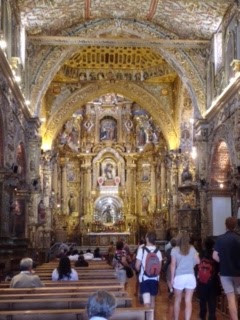
We spent Wednesday touring the old town on foot with its green squares patrolled by municipal police on Segways, splendid churches, and numerous museums.  We walked from Independence Square to the Iglesia de la Compania de Jesus (Church of the Society of Jesus Quito).  The church took 160 years from 1605 to 1765 to build, and is the utmost expression of the Baroque style in Ecuador.  It was a fabulous building, every available surface carved, painted gilded or decorated.  The Jesuits had to train an entire local workforce of carpenters, stonemasons, carvers, painters, artists, sculptors etc.


It is hard to imagine any modern entity or government undertaking such a massive project that took generations to complete and still retained the focus of the original plans. It has been partially rebuilt 2 or 3 times due to earthquake damage;  the most recent restoration taking place from 1987 to 2005.

We also visited the San Francisco compound, which consists of a Church, Monastery, museum and the square.  The church was built by the Franciscans and makes a big effort to be as ornate as the Jesuits.  I thought they were supposed to be a mendicant order. The church is Baroque again, but smaller and in worse repair.  It is still splendid and magnificent, and has a huge ongoing restoration program.  We saw some of the restoration workers in the church and near the workshop area they had set up on the upper balcony of the monastery.   Part of the monastery is now a museum of a huge display of religious art made by local artisans and artists of the"Quitenian School".  From the monastery/museum you can access the church choir balcony and get a stunning view of the church from the upper levels.

There are many more churches in Quito, including the magnificent municipal "La Catedral", but we only had limited time.  We also visited the Museo Casa del Alabado.
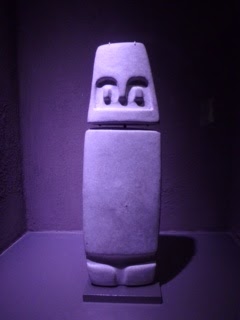
 This is a beautiful little museum of Pre-Columbian Art. 
  The works are thoughtfully displayed and lighted, and every work is a gem.  They are arranged thematically, describing the place of these works in the native religion, world view and cosmos.


Thursday brought another horribly early start to the airport (could Bill have really arranged these flights?)  We flew via Guayaquil to Baltra in the  Galapagos.   For me, this last week has been the highlight of our trip.  We have been on a 'budget" cruise on the ship Darwin around the islands.  The boat is clean and comfortable, if small.  The guide speaks a tortured English but manages to get his ideas across.  It is much better than my non-existent Spanish.  We have been to about 8 islands with snorkelling every day, visits to giant tortoise protection areas and breeding centres, and a few hours in the small towns.  Every island is a revelation, and every one is different.  You can really see and understand Darwin's theories here.  Yesterday we were on two different islands with the Opuntia cactus.  On one, the cactus was short and had soft spines as it had no species that used it as a major food source.  On the second island, the cactus was tall, had a tree-like hard trunk and thick, spiky spines.  Here the giant tortoise and land iguana eat the cactus, so it had developed protective features.

There are many beautiful and diverse beaches, of white or red or golden and even black sand on the various islands.  The water is clear and turquoise.  The fish life everywhere has been colourful and abundant.  I must have over 100 photos (after culling) of fish every day.  The corals are not so colourful or thick as we are accustomed to see in Australia.  There are also many other water animals to look for, including sharks, turtles, galapagos penguins and sea lions.  The bird life is also interesting and many birds are easy to approach quite closely, including the red and blue footed boobies.  We have also seen frigate birds, flamingos, galapagos storm petrels, brown pelicans, galapagos mockingbirds, yellow warblers with a melodious song, and many of the Darwin finches.

 The Galapagos has been the highlight of our trip so far for me.
Tomorrow we finish our cruise on the Darwin and head for the Ecuadorian Rainforest near Coca. Till next time.

Sunday, 12 October 2014

Out of Africa 3 Kruger, Okavonga, and Victoria Falls

We left you as we arrived in Johannesburg by train, picked up our VW polo hatch and headed for Kruger NP. Overnight in Middleburg in a nice BNB and then 6 nights in Kruger. On the first game drive (on our own) we saw a very fat, well fed, leopard sleeping in a tree,  and later we saw a leopard's kill hanging in a tree, but missed seeing the leopard. We stayed at 4 different camps during the stay, and every day we drove around seeing gazelles, kudu, hippos, elephants, giraffes, warthogs, cape buffalo, vultures, honey badgers, and more. Had to backup on one road, to give the elephant, who was pawing the ground,  right of way.
Fat Leopard

Elephant Crossing

One morning, we had a personal guided walk with armed rangers thru the park. Most animals were scared of us, and stayed far away. We did, however, see fresh lion tracks as we were returning to our vehicle - disappointing as we didn't see any other lions in Kruger.

Next stop was Johannesburg again, over some potholes caused by coal mining trucks,  and then off to the Okavonga Delta.  Gunn's Camp was without Wi-Fi but otherwise 4 star. Excellent food, (and lots of it--5 meals a day!!) with morning and afternoon boat or mokoro (poled fibreglass dugouts) trips thru the Delta. Sundowners, one evening next to 3 hippos in a pool, were a highlight of the day. The nights were also interesting with elephants wandering through the camp, knocking down trees and railings. We were obviously not allowed to go out of our tent at night!
Okavonga Sunset

Hippo Pool

We were sad to leave the tranquil green marshes and rivers of the Okvango Delta,  but our next adventure beckoned.  We flew from our camp to Kasane in Northern Botswana,  and from there by car to Zimbabwe and the famous Victoria Falls.

We are now about to leave Victoria Falls, after 2 nights here. Seeing the falls took about 2 hours and US $30pp, but even now, in the dry season - spectacular! The rest of the time we checked out all the shops, watched the adventure tourists white water rafting and zip-lining, beat off the street sellers with a stick, swam in the hotel pool and ate. Dieting is going to be required, on returning home!  Victoria Falls was also the worst place for mosquitos that we have encountered.  And they are totally silent,  no high pitched whine to give you an early warning they are about to attack.
Victoria Falls

2 more days in Johannesburg to see Soweto and the apartheid museum, and 2 nights in Perth, and we will be home. Final blog will probably be from Yamba...


Saturday, 27 September 2014

Out of Africa 2 Cape Town & Western Cape

Our last blog ended with us descending Table Mountain and ending up with very sore legs that persisted for a few days.    Before we left Cape Town we also visited the Kirstenbosch Botanical Gardens,  an awesome spread of beautiful  plantings on the lower slopes of Table Mountain,  with the mountain itself as a backdrop.  The spring flowers were beautiful,  especially the hedges of Bird of Paradise in orange and yellow. We also visited the V and A Waterfront, an upmarket shopping mall on part of the old harbour. We thought about going to Robben Island, where Nelson Mandela was imprisoned,   but the grey, stormy weather and rough seas put paid to that idea.
We also visited Green Market Square, an area that used to be a handmade craft market,  but is now just immigrant Nigerian and Somali traders selling the ususal tourist junk.


Leaving Cape Town the next day we drove along the coast via the stunning  Chapman's Peak Drive that clings to the ciffs as it winds its way along the coast to Cape of Good Hope and the Cape Point Lighthouse. We took the funicular railway most of the way up to the lighthouse. The wind was very cold and blowing a gale,  interspersed with showers of horizontal rain. The area is wildly beautiful with heathlands,  craggy rocks and peaks,  and pounding surf on the shore. 
Cape of Good Hope

We also stopped at The  Boulders, an African Penguin Sanctuary where we watched the release of some rehabilitated penguins back into the wild.

We spent the next few days making our way north up the spectacular west coast of South Africa.  It is an area of numerous mountain ranges, often marching right to the shore in steep cliffs and crevasses, interspersed with white sand beaches. We stayed with lovely people we contacted through airbnb.   After many stops at beautiful places on the coast including Hermanus, Mossel Bay and the very unaptly named suburb of Wilderness, we ended up in Knysna (pronounced Nys nah). This is a beautiful tranquil bay with magnificent rock cliffs forming the heads either side of a narrow channel to the ocean. We stayed here three days and visited the awesome Storms River Mouth to the north where we hiked to the river mouth and up a very steep climb to a lookout.
Knysna

Storms Bay
We also took a cruise to Knysna Heads and hiked down through the Featherbed Reserve to a tasty lunch at a Featherbed Restaurant looking out at the lagoons and the heads.
We drove back to Cape Town via the inland route to Outdshoorn.  We did the tourist thing and visited the Cango Caves and an Ostrich farm.  Bill took a ride on an Ostrich, but it was so quick, there is no photographic evidence. Did you know that Ostrich is the second toughest leather in the world (after Kangaroo)? We crossed many mountain ranges interspersed with fertile valleys and endless green and well managed farms.  We became connoisseurs of mountain passes  and river valleys through the ranges.   The highway engineering here is truly amazing with excellent quality roads twisting and climbing through rocky gorges and divides.  The roads of all types from expressways to gravel are of excellent quality and all in good repair.
We made our way back to Cape Town through the wine regions and pretty towns of Franschhoek and Stellenbosch.   We sampled some wine in the Robertson area, had an excellent lunch in Franschhoek, and did a walking tour of the museums and heritage Cape Architecture in Stellenbosch.
Stellenbosch

Afrikaans is spoken  widely here,  although most people speak excellent English as well. We were occasionally flummoxed by town street signs with English on one side and a different Afrikaans name on the other.  And a grocery store aisle with signs for versnaperings,  grondboontijes,  verromers,  skyties,  sjampanje,  langlewe sap,  stroopdrank and doos wyn had me worried about what we were going to eat.    But food is very  cheap here in restaurants and supermarkets,  and there are lots of ready to eat meals in the supermarkets so we have eaten well.
Most of all,  the South Africans we met have been wonderful.  We can't fault their kindness,  generosity and helpfulness. They are true tourist ambassadors for their country and have willingly offered food and drink,  rides,  use of a car,  help with washing our (very dirty) rental car--we can't resist a gravel road:  nothing was too hard.   Their only failing is they can't help showing their disappointment that you didn't spend your entire South African vacation in their part of the country that is obviously the best possible place to be.
We have returned our little rental VW Polo to Cape Town and embarked on the Shosholoza Meyl train from Cape Town to Johannesburg.  Our cramped sleeper cabin with purple leatherette upholstry looks like something out of the 1950's but it is running to time so far. Look out for our next installment.
Train travel is tiring

Tuesday, 16 September 2014

Hello blog followers. Some of you may know that we are on trip through Africa.   We haven't published for the first two weeks as many of the places we were staying had marginal and/or very expensive  internet.  But now we are in Cape Town SA and back in the electronic world.

We flew out of Brisbane on 29 August.   Our trip did not get off to a flying start as Virgin cancelled our flight to Perth,  apparently due to a shortage of cabin crew!! Not very impressive.  The later flight that they put us on missed our  connection to Johannesburg, so we spent an unscheduled night in Perth. We arrived at our eventual destination,  Nairobi Kenya,  a day late.  Luckily, we had planned to be in Nairobi a day before our Safari started,  so we did not miss that  but we did miss out on looking around Nairobi.

Our Kenya Safari started by driving out of Nairobi,  across the Great Rift Valley,  and into the Masai Mara. Mara Simba Lodge greeted us with elephants at the front gate,  and crocodile and hippos in the river behind the lodge.   On our first evening game drive we were overwhelmed by the numbers and variety of game that we saw,  including lions, wildebeest, gazelles, warthogs,  zebra, cape buffalo, giraffe, and a rare black rhino.  And all in just two hours!!


Our time in Kenya  continued in this vein in all of of the parks that we visited.   In Lake Nakuru NP we saw wonderful bird life including large groups of flamingos and beautiful crested  cranes. In Lake Naivasha NP we took a boat cruise and got up close to a mother and  baby hippo,  as well as seeing fish eagles.   Both of these lakes are in a string of water  bodies that run down the Great Rift Valley.

Our last National Park in Kenya was Amboseli, located at the base of Mount Kilimanjaro.   Unfortunately,  during our whole stay there the mountain was shrouded  in clouds and we never got to see it. We did see more interesting birds including Ostrich,  Kori Bustards and Secretary Birds.   Our main interest this trip was wildlife and Kenya was awesome.

The second week of our Safari took us into Tanzania,  and out to the Serengeti Desert. The sky in the Serengeti never ends.  The vistas are vast and empty.   Animals were not as concentrated as in the Masai Mara,  but we did see vast herds of wildebeest and zebra stretching to the horizon on their annual migration.  We also saw our first leopards, a mother cheetah and cub, and prides of lions. At one point a grumpy elephant charged us,  but luckily he was  not as fast as a Land Cruiser.

We also visted Ngorongoro  Crater,  an incredible circular plain surrounded mountain ranges.   Our hotel was high on the crater edge and we  could gaze down into it from our rooms. We spent a beautiful day down in the crater,  where we had breakfast beside a pool full of hippos.   We later watched anothef huge group of hippos take mud baths and roll over to coat themselves with mud.   An upside down hippo,  kicking his feet in the air, is a never to be forgotten sight.

In between game drives,  we managed a few other activities,  including an early morning  ballon flight and visit to a Masai village in Kenya,  and guided nature walks and Swahili  lessons in Tanzania. (The most useful words of Swahili we learned were "hakuna metata"--"no problem")

We have left Safari life behind for the immediate future,  and are now in Cape Town SA.  We are staying at a beautiful bed and breakfast house in Geen Point,  on a hill overlooking the Atlantic Ocean and the stadium built for the 2010 world cup.   Today we took the cable car up through the  clouds to Table Mountain,  then walked to the highest point at Maclear's Beacon.   We later walked down the mountain via Platteklip Gorge,  a spectacular 2 hour walk that left us with jelly legs and and aching knees. A local member of one of the mountaineering clubs took pity on us and offered us a ride back to our accommodation.   We gratefully accepted,  and shared a beer with him at a pub on the way home.

We are staying in Cape Town for 2 more days,  then picking up a rental car and heading up the east  coast.   Stay tuned for more adventures.


Friday, 3 January 2014

2013 YE Report from Yamba

Friends,
Here I am, on Christmas day, dictating the newsletter to my phone. 2013 was a busy year for us settling into our new home in Yamba. We just celebrated 1 year in Yamba with a party on our back deck for 30 people. All were new friends and their partners we've met since we moved here. Most of the year we've spent setting up our new home. We added a pantry and dishwasher to the kitchen, installed 2 televisions, built-in wardrobes in both bedrooms (who builds houses without wardrobes?!), weeded the yard and did the inevitable maintenance on the the two tenant's places.
Bobbie has re-established  her jewellery studio, and is making and selling the creative results.  She has also joined the local Arts an Crafts Group and has her jewellery for sale in their co-op gallery at nearby Maclean.  A piece she entered in their annual award show was highly commended.  Not too bad for a first go. Bill has refurbished his boat and has finally completed a club race just before Christmas. He has also taken Bobbie's cousin Janet (visiting from Canada) for a sail.
We had an exciting introduction to life in the sub-tropics during January to March of 2013.  During January, massive storms flooded and washed tons of driftwood down the Clarence River that flows through Yamba.  Instead of moving out to sea, as it usually does, the wood washed back onto all of our beaches, up to a metre deep in places, leaving the local Council with a massive clean-up headache.  The heavy flooding also caused a lot of damage in low-lying areas and Yamba was cut off from the main highway for 5 days.  Luckily, our house is up quite high so the flooding does not affect us.  Later in March, storms again cut the Pacific Highway near the coast. This forced us to travel to Sydney via the New England Highway (the inland route) on our way to meet friends in Sydney.

As far as travel is concerned, we have been back to Sydney (700 km) 3 times. Bobbie was also back in Canada  in November, as her mother, Lucille, passed away this year and she went back to spend some time with her sister Naomi and settle the estate. During the year we also spent 10 days minding a motel. A friend of Bobbie's, who owns the motel in Hawks Nest (about 2 hours north of Sydney) needed a vacation to visit her daughter in Vanuatu. We haven't completely forgotten about our camping and have been camping for 2 weekends in nearby national parks. We also spent two weeks travelling and camping with Canadian friends Mike and Rhonda when they visited Australia for 3 months.  It was good to catch up with them and share some travels.  They later visited us in Yamba before heading home. No long trips were taken but our plan is to do more camping in the new year. We have also been to Port Macquarie to a craftshow/ exhibition where Bobbie displayed and sold some jewellery. In Port Macquarie we stayed with a friend Peter Thompson and caught up with Dave Moxon another old friend from Sydney

We are thoroughly enjoying the slow and easy life in Yamba with a weekly routine much different from that in Sydney. On a normal day we walk to the beach and go for a run and/or a swim. Bill dips his toe in occasionally Bobbie always swims. Wednesday is market day, in the park near the lighthouse, where we pick up fresh fruit and vegetables for the week after our trip to beach. Additionally Bobbie swims 3 times a week with the local masters swim club as well as swimming on Sundays with the surf club as she has for many years now.  She has also joined the local surf club and is already involved in an executive role. Bill does the sailing race most wednesdays, and usually goes to the Yacht Club bar on Friday nights.
Keeping fit and doing regular exercise has insured our health has remained good despite Bill having a swollen foot and cellulitis from an ant or spider bite and spending a couple of weeks recovering.
In other activities Bobbie has been going to the Men's Shed (oops Women's Shed) every Friday and has completed several projects. The first was a wooden toolbox so she can carry her tools to and from the shed. The second was refinishing a stool and the third is a very elaborate 11 spool clothes rack to hang under the model boat ( built by her grandfather ) which functions as a hat shelf by our front door. See picture below

P. S. Dictating to the phone was OK, but the extensive editing required didn't save much time. BTW my new phone is a Phablet - Sony Xperia Z Ultra with 6.44“ screen...
Best wishes for the New Year and we hope it is happy and healthy for you.
Cheers,
BiLL & Bobbie
M: 0411 877 499 / 0412 832